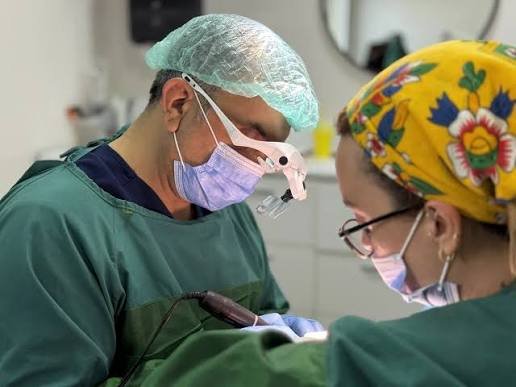
When patients research hair restoration, one question matters more than any technology or price list: who will actually perform my surgery? In the global hair transplant industry, the answer varies widely. In some clinics, the physician carries out the essential steps and supervises the rest. In others, much of the work is delegated to technicians, with the doctor present for only part of the procedure or not at all. This article explains why the question matters, what regulators and professional bodies expect, and how to recognise a genuinely surgeon-led hair transplant.
The technician model and the surgeon-led model
Hair transplantation involves distinct tasks: diagnosis and planning, hairline design, anaesthesia, graft extraction, recipient-site creation and graft implantation. How these tasks are divided defines the clinic’s model.
In a technician-based model, trained technicians perform a large part of the extraction and implantation, while the physician handles some steps, such as design and anaesthesia, and moves between rooms. This arrangement can be efficient and, when properly supervised by an experienced team, can deliver good results. It also enables clinics to treat many patients per day and offer lower prices.
In a surgeon-led model, the physician is directly responsible for the critical decisions and performs, or closely supervises, the key stages. Technical staff assist, but the surgeon controls the elements that determine appearance and safety: the hairline, the recipient channels and the distribution of grafts. The approach demands more of the surgeon’s time, so it tends to be offered by clinics that schedule fewer patients per day.
Why the distinction matters to patients
The difference is not only about prestige. Several elements of the operation have an outsized influence on the final result, and they are the ones patients should want a qualified physician to control.
What the rules say
Medical regulations in many countries treat hair transplantation as a surgical procedure that must be performed under the responsibility of a licensed physician, in a licensed facility. Details differ between jurisdictions, and the extent to which trained non-physician staff can carry out parts of the work varies. Patients should therefore not assume that every step is regulated in the same way everywhere.
A practical approach is to ask each clinic which steps are performed by the physician and which by other staff, to request the names and qualifications of everyone involved in the operation, and to confirm that the facility is licensed. Reputable clinics answer these questions without difficulty, and the answers should match what is written in the agreement.
How Hairmedico Clinic describes its approach
Hairmedico Clinic in Istanbul presents itself as a surgeon-led practice. It was founded by Dr. Arslan Musbeh, who graduated from Odessa State Medical University in 2000, is an active member of FUE Europe, and has been a faculty instructor on the DIU Calvitie programme at Université Claude Bernard Lyon 1 since 2019. The clinic operates in Istanbul’s Levent and Beşiktaş districts and schedules one patient per day, so that the lead surgeon can be involved throughout the operation.
The clinic reports more than 4,500 procedures, of which more than 3,000 were performed personally by Dr. Musbeh. It also uses a structured planning approach branded Algorithmic FUE. As with any clinic’s claims, patients should treat these statements as a prompt for questions: how are the tasks divided during the operation, which steps does Dr. Arslan Musbeh perform himself, and how is the work of the assisting team supervised?
Six questions that reveal a clinic’s real model
The answers should be specific. Phrases such as “our expert team” or “the doctor supervises” without further detail do not tell the patient what is actually happening in the operating room.
Experience, volume and training
A surgeon’s experience is relevant, but it needs to be interpreted carefully. A very large number of procedures can reflect real expertise, or it can reflect a high-volume operation in which many of those procedures were performed by others under the surgeon’s name. For this reason, the most useful question is how many procedures the named surgeon has personally performed, not how many the clinic has billed.
Training and teaching add another dimension. Surgeons who contribute to university programmes, take part in professional meetings and publish or present their methods expose their work to peer review. This does not guarantee any individual result, but it is a useful signal of engagement with professional standards. Patients can verify such claims with the institutions involved, for example by checking a university programme’s faculty list or a society’s member directory.
The patient’s journey in a surgeon-led clinic
A surgeon-led practice tends to place the physician at the centre of the whole journey, from the first consultation to the last follow-up. In practice, patients should expect the following sequence.
Before surgery. The surgeon or a physician reviews photographs and medical history, discusses the diagnosis, explains whether and when a transplant is appropriate, and outlines the plan. The patient receives written pre-operative instructions.
On the day. The surgeon confirms the plan, designs the hairline together with the patient, and supervises or performs the main stages of the operation. The patient should be able to ask questions throughout the day and receive answers from the physician.
After surgery. Written aftercare instructions explain washing, sleeping position, medication and activity. A review is scheduled for the first days, and further reviews take place over the following months, often through photographs.
Through the first year. The surgeon monitors growth, explains the normal shedding phase, and decides whether complementary therapy is advisable. The final result is assessed after about twelve months.
Does a surgeon-led clinic cost more?
Often, yes. The physician’s time is the most valuable resource in the operating room, and a model that requires more of it must charge accordingly. Limited daily capacity also raises the price per procedure. The relevant question is whether the additional cost buys something of real value: direct surgeon involvement, unhurried planning, controlled graft handling and reliable follow-up.
For many patients, particularly those with complex needs, the answer is yes. For others with straightforward cases, a transparent clinic with strong supervision and a team of experienced technicians may be a perfectly sound choice. What matters is that the clinic is honest about its model and that the patient is able to choose knowingly.
Common misconceptions
“A famous device means a better result.” Tools can help, but they do not replace the surgeon’s planning and judgement. A device in unskilled hands can cause damage.
“A technician-led clinic is always unsafe.” Not necessarily. Well-trained, closely supervised teams can deliver good results. The concern arises when responsibility is unclear or supervision is minimal.
“If the surgeon is named, the surgeon operates.” Not always. A name on a brochure does not prove who performs each step, which is why patients should ask directly.
“More grafts always means a better result.” Quality, placement and survival matter as much as quantity, and over-harvesting damages the donor area.
“Guarantees are a sign of confidence.” In medicine, no honest surgeon can guarantee a precise outcome. Responsible clinics describe expected results and risks and avoid absolute promises.
Special cases that call for a surgeon’s personal involvement
Certain situations benefit particularly from direct physician involvement. Repair procedures, in which a previous transplant must be corrected, require careful judgement about what donor hair remains and how to use it. Afro-textured hair, with its curled follicles, needs adapted extraction techniques. Women with diffuse thinning often need a medical work-up and a more delicate approach. Facial work on the beard or eyebrows involves fine angles and density control. In each of these situations, patients should ask the surgeon to describe their experience with comparable cases and to show documented results.
Language, access and follow-up
A surgeon-led model only works for international patients if communication is clear. Patients should be able to discuss the plan in a language they understand and to reach the physician or the medical team after returning home. Dr. Arslan Musbeh speaks French, Russian and Turkish fluently, and Hairmedico Clinic maintains consultation hubs in Paris and Luxembourg to help European patients prepare before travelling. Whatever clinic you consider, ask how follow-up works in practice: how often photographs are reviewed, who responds, and how quickly.
How to verify what a clinic tells you
Before you decide
Choosing a surgeon is the most important decision in a hair transplant, and it deserves time. Speak with more than one practice, including Hairmedico Clinic and others, ask each the same questions, and compare how clearly and consistently they answer. Be cautious about pressure to decide quickly, about fixed promises made before an examination, and about any reluctance to say who will perform the surgery.
The bottom line
The distinction between surgeon-led and technician-led models is one of the most important and least understood in hair restoration. A surgeon who is directly responsible for the critical steps, supported by a disciplined team and a clear follow-up plan, offers conditions in which a natural, durable result is most achievable. Clinics such as Hairmedico Clinic, led by Dr. Arslan Musbeh, make that principle central to their way of working. Wherever you choose to be treated, insist on a clear answer to the simplest question: who will operate on me?
Frequently asked questions
Can a non-physician legally perform part of a hair transplant? The rules differ by country, and in many places specific steps are expected to be performed or directly supervised by a licensed physician. Patients should ask the clinic what applies in its jurisdiction and who performs each step, and should not rely on general assurances.
Is the surgeon present for the whole operation? This varies. Some surgeons remain in the room for the entire procedure, while others move between rooms or are present for selected stages. Ask for a clear description of the surgeon’s presence and put the answer in writing.
How do I know who is operating on me? Request the names and roles of everyone who will take part, and ask to meet the team before the day of surgery. A clinic that works transparently will welcome the request.
Does the surgeon-led model improve survival of the grafts? Graft survival depends on gentle handling, short time outside the body, correct channel depth and careful implantation. A surgeon who supervises these steps closely can help to maintain good practice, but results depend on the whole team and on aftercare.
What if my plan changes during the operation? Occasionally, the surgeon may need to adapt the plan, for example if donor hair is less dense than expected. A surgeon who is present and in control can make and explain such decisions in real time.
The importance of the consultation
The first consultation is the best opportunity to learn how a clinic really works. It should be conducted by a physician, or at least include a physician’s input, and should result in an individual assessment. Patients should expect questions about their medical history, family pattern of hair loss, medication, previous treatments and goals. They should expect a realistic discussion of what the donor area can provide and what the limits are.
The consultation is also the right moment to discuss the hairline. A good surgeon will explain why a certain height and shape suit the patient’s face and age, will show the proposed design, and will adapt it according to the patient’s preferences within safe limits. If the surgeon is not part of this conversation, or if the design is handled entirely by sales staff, the patient has little reason to believe the surgeon is truly leading the plan.
How supervision works in practice
Even in the most surgeon-led clinics, assistants contribute. The question is how their work is supervised and who is responsible for the outcome. A well-structured team has defined roles, written protocols and regular quality checks. The surgeon checks the quality of extracted grafts, verifies the direction and depth of channels, and reviews the implantation. Staff are trained for specific tasks and work under the physician’s direction.
Patients can ask how the clinic trains and evaluates its assistants, how errors are identified and corrected, and what the surgeon personally reviews during the operation. Detailed answers indicate a culture of oversight, while vague ones suggest that responsibility is loosely defined.
Surgical pacing and attention
The number of patients treated per day shapes how much attention each one receives. When a team operates on several patients in parallel, the physician has to divide his or her time, and some decisions are inevitably taken by others. A schedule with a single patient per day, such as the one used at Hairmedico Clinic, removes that division and allows Dr. Arslan Musbeh to remain involved throughout. This does not make the surgeon infallible, but it does remove an avoidable constraint on attention.
Patients should ask any clinic how many surgical procedures run at the same time, how long the operation lasts, and how breaks are handled. These practical details say more about a clinic’s workflow than any brochure.
Aftercare and long-term relationship
The surgeon’s responsibility does not end when the operation is over. The first weeks involve crusts, swelling, shedding and sometimes anxiety, and patients benefit from a clear route to ask questions. In the following months, the new hair appears gradually, with a result that is normally judged at around twelve months. A clinic that is surgeon-led in the full sense will have the physician involved in this monitoring as well.
Patients can look for evidence of structured follow-up: scheduled review points, a defined method for sending photographs, a stated response time, and clear criteria for when to seek an in-person check. They should also ask what happens in the unlikely event of a complication after they have returned home.
Making your own checklist
Before choosing a clinic, it helps to write a short checklist and use it for each consultation:
Completing the checklist for two or three clinics gives a clear, factual comparison and reduces the influence of marketing.
A final word of caution
Terms such as “surgeon-led” and “doctor-performed” are used loosely in the industry, and they do not always mean the same thing. Patients should look at the substance: who does what, how long the physician is present, and how responsibility is defined. Ask for specifics, and compare them with what you see and hear during the consultation. If the details are hard to obtain, take that as information.
This article is for general information only and does not replace individual medical advice. Results vary between patients, and no outcome can be guaranteed.