Mumbai’s expanding urban footprint has encouraged homebuyers and developers to explore residential markets beyond the city’s established neighbourhoods. One location that has increasingly attracted attention is Boisar in Palghar district, Maharashtra.
Historically known for its industrial activity, Boisar has gradually developed into a more established residential market. The availability of land, proximity to employment centres, railway connectivity and expanding social infrastructure are some of the factors supporting residential development in the area.
For buyers considering property beyond Mumbai, understanding what is driving Boisar’s growth can help them assess whether the location fits their long-term requirements.
1. The Presence of the Tarapur Industrial Area
One of the biggest factors supporting Boisar’s local economy is its proximity to the Tarapur Industrial Area.
The industrial belt provides employment across multiple sectors and has created demand for housing from employees and their families. Unlike purely speculative residential markets, Boisar has an existing employment ecosystem that contributes to its housing demand.
As industrial and commercial activity develops, the requirement for nearby housing, retail, transportation and other supporting services can also increase.
This connection between employment and housing is an important factor when evaluating the long-term development of any residential market.
2. Availability of Land for Residential Development
Land availability is another factor influencing Boisar’s residential growth.
Compared with highly developed urban areas of Mumbai, peripheral markets generally offer developers greater scope to acquire larger parcels of land. This can support residential projects with larger layouts, open spaces and community facilities.
For homebuyers, this creates opportunities to consider different formats of housing rather than being restricted to compact apartments in densely populated areas.
The availability of larger land parcels is also encouraging interest in planned residential communities and plotted developments.
3. Railway Connectivity Supports Everyday Commuting
Boisar has an established railway station on the Western Railway network, providing rail connectivity towards Mumbai and other parts of Maharashtra.
Rail connectivity is particularly important for a developing residential location because it provides residents with an established public transport option.
However, buyers should consider their actual daily commute before purchasing. Travel time depends on the final destination, train availability and the additional journey between the station and workplace.
Therefore, proximity to a railway station should be considered alongside road connectivity and workplace location.
4. The Mumbai–Ahmedabad High-Speed Rail Project
Future infrastructure is another factor that has contributed to interest in the Boisar property market.
Boisar is included among the proposed stations on the Mumbai–Ahmedabad High-Speed Rail corridor. The project is being developed by the National High Speed Rail Corporation Limited and is planned to connect Mumbai with Ahmedabad through a high-speed rail network.
The proposed infrastructure has increased attention towards the broader Boisar region.
However, buyers should distinguish between infrastructure that is operational today and projects that are still under development. Future connectivity can be considered as a potential long-term factor, but it should not replace an assessment of the location’s current accessibility.
5. Growing Residential Supply
As demand for housing has increased, developers have introduced more residential projects across Boisar.
The market includes conventional apartment developments as well as larger communities and plotted developments. This growing supply gives buyers more choices in terms of configuration, project size, amenities and budget.
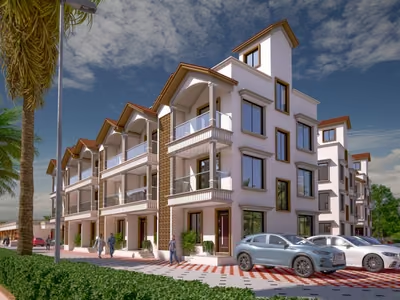
The emergence of developments such as Birla Mrida reflects this broader shift towards planned residential environments in Boisar.
For buyers, increasing supply also means greater importance should be given to comparing projects rather than selecting a property based solely on the reputation of the location.
6. Increasing Social Infrastructure
A residential market can sustain long-term growth only when housing is supported by everyday infrastructure.
Boisar has seen the development of schools, healthcare facilities, retail outlets, restaurants and other services alongside its growing population.
For families considering the area, access to these facilities can be as important as the property itself.
Before buying, prospective homeowners should check the actual distance from the project to schools, hospitals, supermarkets and other essential services.
7. The Demand for Larger and More Open Residential Communities
The preference for larger homes and open spaces has become more noticeable among many homebuyers.
In established parts of Mumbai, limited land availability can make large residential communities difficult to develop. Emerging locations such as Boisar offer greater scope for projects designed around larger land parcels.
This can allow developers to incorporate:
- Landscaped areas
- Walking spaces
- Community facilities
- Recreational zones
- Children’s play areas
- Larger internal roads
- Open spaces
For families, these features can contribute to a different residential experience compared with high-density urban housing.
8. Changing Homebuyer Preferences
Homebuyers today often evaluate more than just the size and price of an apartment.
Factors such as commute, community amenities, open spaces, neighbourhood development and access to essential services can influence the purchase decision.
This is particularly relevant for buyers who are willing to live farther from central Mumbai in exchange for greater residential space and a different lifestyle.
Boisar’s developing residential market provides an opportunity to evaluate these trade-offs.
9. The Role of Employment in Residential Demand
Employment remains one of the strongest underlying drivers of residential demand.
Boisar’s connection with the Tarapur industrial ecosystem provides a local employment base, while its broader railway and road connectivity gives residents access to employment opportunities in surrounding areas.
When evaluating the property market, buyers should therefore consider both local employment and regional accessibility.
A residential location with multiple employment catchments can potentially have a broader buyer and rental audience than a location dependent on a single future infrastructure project.
10. Planned Developments Can Change the Residential Landscape
As emerging locations mature, residential development can gradually shift from individual buildings to larger, planned communities.
Planned developments can provide residents with internal infrastructure, common facilities, landscaped areas and a more organised layout.
For homebuyers, this means the project itself becomes an important part of the location assessment.
Two properties located in the same part of Boisar can offer very different living experiences depending on their planning, amenities, construction quality and surrounding infrastructure.
11. What Should Buyers Check Before Purchasing Property in Boisar?
While the growth story is important, buyers should also conduct thorough project-level due diligence.
Verify regulatory details
Check the applicable approvals and MahaRERA registration, where applicable.
Evaluate the developer
Review previous projects, delivery history and construction quality.
Check connectivity personally
Visit the property during peak traffic hours and understand the actual commute.
Assess nearby infrastructure
Check schools, hospitals, retail, public transport and other daily necessities.
Compare the total cost
Consider registration, taxes, maintenance, parking and other applicable charges rather than focusing only on the advertised property price.
Understand the development timeline
For under-construction projects, verify the current construction stage and committed possession timeline.
12. Current Infrastructure vs Future Potential
One of the most important things to remember when evaluating an emerging real estate market is that future potential and present-day reality are not the same thing.
Boisar already has an established industrial ecosystem, railway connectivity and a growing residential base.
At the same time, proposed infrastructure and future development could influence the area’s long-term growth.
A sensible property assessment should therefore consider both:
What is available today
- Existing roads
- Railway connectivity
- Employment centres
- Schools and healthcare
- Retail and daily conveniences
What could develop in the future
- New infrastructure
- Additional residential communities
- Improved connectivity
- Expansion of social infrastructure
This distinction helps buyers make decisions based on realistic expectations.
Conclusion
The growth of Boisar real estate is being shaped by several interconnected factors rather than a single development.
Its proximity to the Tarapur industrial area provides an established employment base, while railway connectivity supports access to surrounding areas. Availability of land has enabled larger residential developments, and the expansion of schools, healthcare, retail and other services is contributing to the area’s evolution as a residential destination.
Future infrastructure, including the proposed Mumbai–Ahmedabad High-Speed Rail corridor, adds another factor to the area’s long-term development story, although buyers should evaluate such projects based on their actual status and timelines.
For prospective homebuyers, Boisar can offer a combination of employment access, residential space and developing infrastructure. The key is to compare individual projects carefully and assess current connectivity, approvals, total costs and long-term requirements before making a purchase.