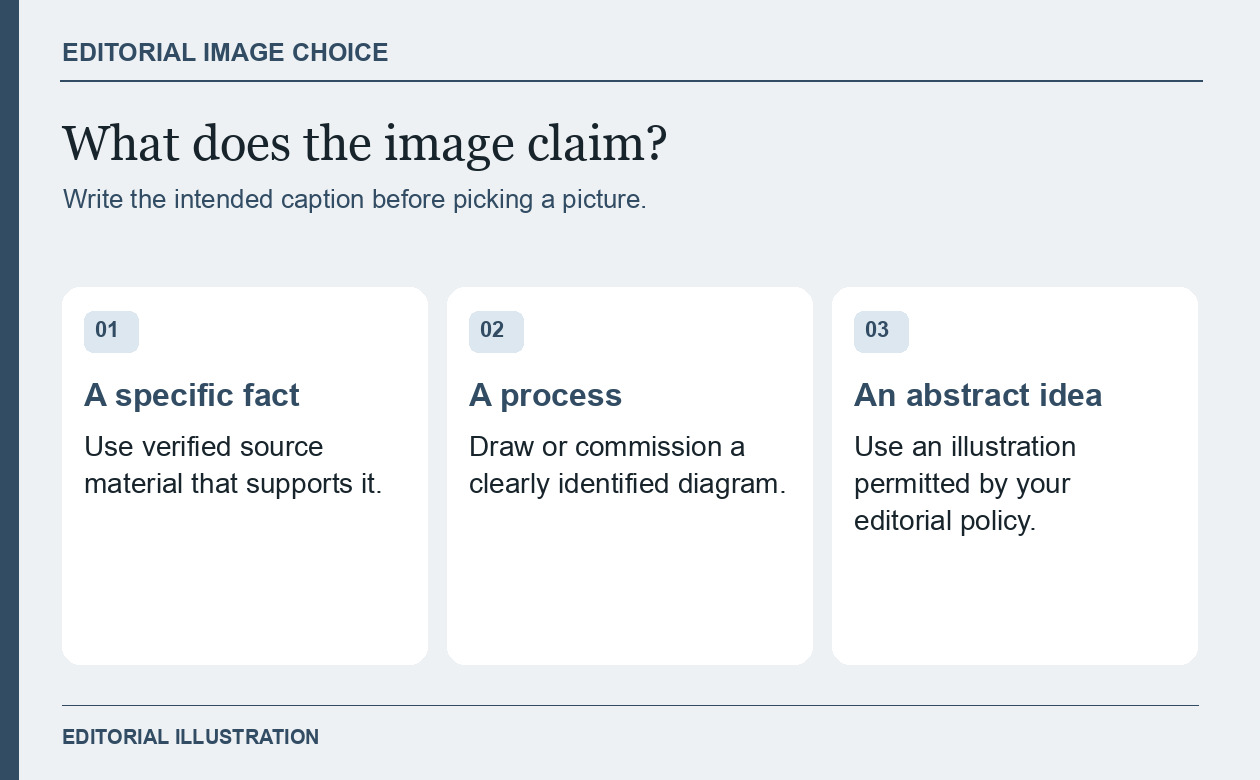
Use a verified photograph when the image is meant to show who was there, what happened, or what an object or place actually looked like. If the image’s job is to clarify a process, you can often use a labeled diagram instead. A calm way to decide is to write the caption before choosing the picture and see whether the caption would claim that an invented scene really happened.
This article was prepared for Uyo as a sponsored placement. The examples are hypothetical editorial decisions.
The claim determines the evidence the visual needs.
Ask what the visual would lead a reader to believe
Imagine an explainer about how towns check drainage grates after heavy rain. A photo of workers standing at a recognizable intersection suggests those people were there at a specific time. To make that claim, find a verified photo you have permission to reproduce or commission one. Confirm the caption’s place, date and connection to the story. If the picture is from a previous year or another location, identify that context.
If your story only needs readers to understand how rain moves from pavement into a drain, a simple diagram can show direction with arrows and a cross-section. Use facts supported by your reporting, keep the labels general where systems vary, and avoid resembling a specific scene you did not document. The same choice applies to a person, a landmark, or a prototype shown as proof of a fact. The stronger the evidentiary claim, the stronger the need for real, verified material.

Use the photo for the scene and the diagram for the mechanism.
Write captions that survive being shared out of context
Place the disclosure next to the visual. “Illustration. Simplified route of street runoff into a drain. It does not depict a specific site.” tells readers what the image conveys. For an AI-assisted graphic, describe the material role of the technology when it matters. “AI-assisted illustration with labels checked against the reporting” can be appropriate if those labels really were checked. Keep the caption with the asset when you reuse it in a newsletter or related story.
The Associated Press newsroom update is one reference for how a newsroom distinguishes AI-generated material from verified reporting and approaches disclosure. Follow your own publisher’s policy. On a team with a stricter rule, use an original diagram or a clearly sourced graphic.
Keep the illustration distinct from your evidence
A reference-image editor can help explore a generic diagram’s backdrop or an illustration layout. For example, Uyo’s image editor allows changes based on an uploaded image and a written instruction. Keep the editorial copy and the source photo in separate files. A generated version should sit in the illustration folder with its own caption, so no one substitutes it for the documented scene by mistake. If accuracy depends on a set of arrows, names or numbers, draw and verify those elements under editorial control.

Put disclosure where the image will be seen.
Before publication, ask a reviewer who has not seen the draft to identify what the picture proves. If they think a generic scene is a photograph of the reported event, the design needs a more clearly illustrative treatment or a different image. If they can explain the mechanism without making an unsupported inference about time, place or identity, the visual can do its intended job.