When winter weather brings freezing temperatures and heavy precipitation, residential properties face an invisible structural challenge. Homeowners often believe that a roof’s primary winter duty is simply shedding weight and blocking incoming moisture. However, the most destructive winter roofing hazard does not originate from external elements alone. Instead, it is caused by an imbalance in thermodynamics between the interior living space, the attic cavity, and the external atmosphere, leading to a destructive phenomenon known as ice damming.
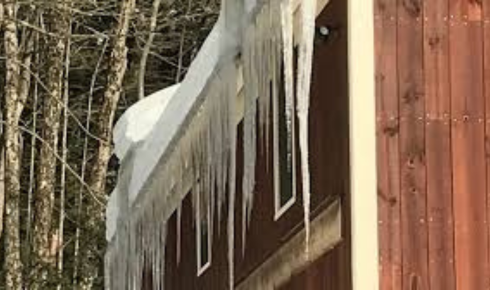
An ice dam is a thick ridge of solid ice that forms along the eaves and gutters of a sloped roof. While it looks like a natural winter formation, it is actually the byproduct of a severe mechanical failure in your home’s insulation and ventilation systems. Understanding the physics behind how these ice barriers develop, the hidden structural rot they cause, and the advanced engineering required to prevent them is vital for safeguarding a property’s long-term value.
The Thermodynamics of Upper-Slope Snowmelt
The lifecycle of an ice dam begins with poor thermal management inside the home. In a perfectly engineered residential structure, the temperature of the roof decking should match the temperature of the outside ambient air. This balance is achieved by placing a thick layer of insulation on the attic floor to trap heat inside the living spaces, paired with a continuous ventilation loop that pulls cold outside air through the attic cavity.
When a home suffers from insufficient insulation or hidden bypasses, such as unsealed recessed light fixtures, gaps around attic access hatches, or uninsulated HVAC ductwork, warmed indoor air escapes directly into the attic. This trapped warmth transforms the attic into a heat reservoir. As the heat rises to the highest point of the structure, it warms the upper sections of the wooden roof decking from underneath.
When a heavy layer of snow blankets the roof, this escaping interior heat begins to melt the bottom layer of snow on the upper slope, even while the outside temperature remains well below freezing. The melting snow turns to liquid water, which percolates downward through the snowpack, traveling along the sloped shingles toward the edge of the roof.
The Freezing Threshold at the Eave Line
The fluid dynamics shift dramatically the moment the melted snow reaches the roof eaves. Unlike the upper portions of the roof, which sit directly above the warmed attic reservoir, the eaves project outward past the exterior walls of the house. This architectural design leaves the underside of the eaves entirely exposed to the freezing outside air from both above and below.
The moment the liquid runoff crosses the boundary from the warm upper slope to the freezing eave line, its temperature drops instantly. The water freezes, solidifying into a thin layer of ice. As the upper-slope heat reservoir continues to melt snow throughout the day, more liquid water flows downward, hits the freezing eave line, and solidifies on top of the initial layer.
Over several days, this continuous cycle builds a massive, solid ridge of ice that completely blocks the path to the gutter system. Once this dam is established, subsequent runoff can no longer flow off the roof. Instead, the liquid water backs up behind the ice barrier, creating a continuous, standing reservoir of meltwater that sits directly on top of your shingles.
The Capillary Action of Trapped Meltwater
The presence of standing water on a sloped roof is an immediate structural crisis. Sloped roofing materials, particularly traditional asphalt shingles, are engineered strictly to shed shedding, gravity-driven water moving downward. They are not designed to be submerged, nor can they withstand hydrostatic pressure or capillary action.
As the meltwater pools behind the ice dam, it seeks out any microscopic gap. Capillary action, the ability of a liquid to flow in narrow spaces against gravity, draws the water horizontally underneath the edges of the shingles. The water easily slips past the overlapping shingle tabs and encounters the underlying waterproofing layer.
In older construction, this underlying layer often consists of basic asphalt-saturated felt paper. When subjected to continuous standing water, the felt paper saturates, softens, and tears. The water then gains direct access to the plywood roof decking. Because this process occurs beneath a heavy blanket of snow and ice, the water intrusion remains entirely hidden from view while it saturates structural rafters, ruins attic insulation, and rots the interior drywall of your upper-story ceilings and walls.
Re-Engineering the Attic Ecosystem for Permanent Prevention
Resolving ice damming requires looking past temporary exterior fixes, such as chopping at the ice with axes or using salt pucks. Hacking at a frozen dam can easily shatter brittle winter shingles, while chemical melts leave behind corrosive residues that destroy gutters and accelerate nail oxidation. A permanent solution requires re-engineering the attic’s thermal boundaries.
The first step involves establishing a continuous air barrier between the living spaces and the attic. Technicians must seal every structural penetration, closing off the hidden pathways that allow warmed air to escape. Next, the attic floor insulation must be upgraded to a higher thermal resistance value, completely isolating the home’s heating footprint from the roof infrastructure.
Simultaneously, the ventilation network must be perfectly balanced. This requires installing a continuous soffit intake ventilation system along the lower eaves, paired with a continuous ridge vent at the absolute peak of the roofline. This configuration utilizes natural convective currents to draw cold ambient air into the attic at the bottom and exhaust any lingering radiant warmth out through the top, ensuring the entire roof deck remains uniformly cold.
Finally, as an essential secondary defense, a heavy-duty, self-adhering elastomeric membrane must be installed along the lower eave lines during any roof overhaul. This specialized ice and water shield adheres directly to the bare wood decking and forms a completely rubberized, waterproof gasket around every single roofing nail driven through it, ensuring that even if severe weather creates temporary pooling, water cannot penetrate the structural boundary.
Securing Advanced Engineering Insight
Because thermal dynamics, airflow physics, and structural geometry vary significantly based on a home’s specific layout, addressing chronic winter roof degradation requires specialized diagnostic training. General contracting operations often recommend generic shingle replacements without addressing the underlying ventilation failures, leading to recurring ice damage and wasted capital.
Preserving the long-term structural health of your property requires a proactive analysis of your home’s exterior envelope before severe weather strikes. Homeowners looking to diagnose insulation gaps, evaluate ventilation balance, or reinforce vulnerable eave boundaries can Call Now for a Free Estimate to schedule a comprehensive, professional attic and roof system inspection. By identifying thermal inconsistencies and engineering correct air loops early, you stop ice formation at the source, protect your interior assets, and keep your residential investment completely secure throughout the year.